Organic Farming Solutions
Organic Soil Amendment
Regenerative Agriculture


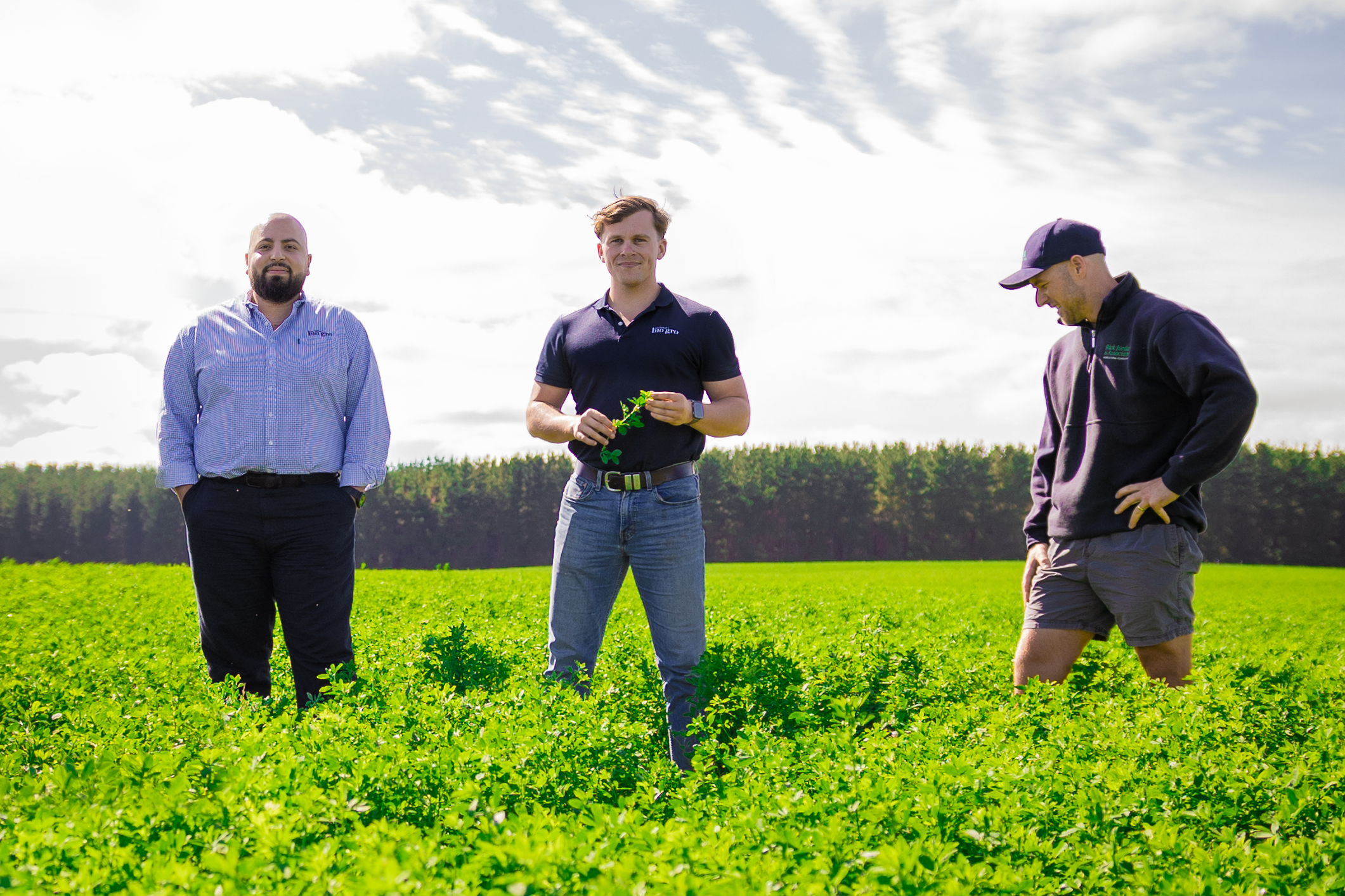
Image: Scott Merrett, Legacy Farm Co with Liam Van Schaik, Bio Gro.
Potatoes are among the highest nutrient-demanding crops grown across Central Victoria, Western Victoria and Southeast South Australia. Producing high-yielding, quality crops requires significant nutrient inputs, making every fertiliser dollar count.
As fertiliser costs continue to rise, growers are increasingly focused on nutrient use efficiency. The question is no longer simply how much fertiliser to apply, but how much of that investment is actually available to the crop when it is needed most.
Healthy soils, active biology and effective root development all play a critical role in helping crops access and utilise nutrients more efficiently.
Potatoes are heavy feeders, and intensive production quickly tests the soil’s ability to supply, hold and cycle nutrients.
NPK remains essential, but yield and quality also depend on root access, organic matter, biological activity, and the soil’s capacity to retain moisture between rainfall and irrigation events.
Nitrogen drives canopy growth in potatoes, but it is easily lost from lighter soils through rainfall or irrigation.
Organic matter helps improve retention, nutrient cycling and biological activity, creating a more reliable supply for the crop through the season.
Phosphorus supports establishment and early root development, but availability is often limited by pH, compaction, moisture and biology.
Stronger root systems allow crops to explore more soil, improving access to water and nutrients without relying only on higher fertiliser rates.
Potassium supports water regulation, nutrient movement, yield potential and crop quality, and both crops remove significant quantities from the soil.
On lighter soils, improving organic matter can help retain potassium, nutrients and moisture so crops can use them more efficiently.
Sulphur and trace elements are needed in smaller amounts but still influence plant function, nutrient movement and crop development.
Regular soil and tissue testing helps identify hidden deficiencies early and guide more targeted nutrient decisions.
Across key potato-growing regions in Victoria and South East South Australia, growers manage a wide range of soil types and production constraints.
Some growers are managing heavier soils where compaction, poor aggregation and restricted root development are ongoing challenges. Others are farming lighter soils where nutrient retention and moisture-holding capacity become key constraints.
Many regions also face issues associated with declining organic matter levels, soil acidity or reduced biological activity.
Because no two farms are identical, the most effective soil improvement strategies are built around local conditions, soil testing and practical agronomic advice.
Healthy soils are home to diverse communities of bacteria, fungi and other beneficial microorganisms.
These microscopic organisms play an important role in:
A healthy soil microbiome helps improve soil function and supports the ongoing release and movement of nutrients throughout the soil profile. This is one reason many growers are placing greater emphasis on building soil organic matter and supporting biological activity as part of broader nutrient management programs.
Different soil constraints require different solutions.
Bio Gro's range of compost-based amendments has been developed to help growers address specific soil challenges while supporting long-term soil health.
AgriGro is a certified 100% compost amendment designed to build soil organic matter, support microbial activity and improve overall soil health. It is well-suited to growers focused on long-term soil improvement and nutrient cycling. AgriGro...
AgriGro +30C combines compost with processed chook manure to deliver additional nutrient input while supporting soil structure and biological activity. AgriGro +30C...
AgriGro +30P combines compost with processed pig manure to provide controlled, rate-dependent nutrition alongside the soil health benefits of compost. AgriGro +30P...
GroBalance blends compost with agricultural lime to support pH correction, improve nutrient availability and increase organic matter levels in acidic soils. GroBalance...
GroBooster combines compost and gypsum to improve soil structure, aggregation and overall soil condition where physical soil constraints may be limiting productivity. GroBooster...
AgriGro Custom allows growers to access a formulation tailored to their specific soil conditions, crop requirements and production objectives. AgriGro Custom...
While compost and soil amendments can play an important role in supporting soil health, they are most effective when integrated into a broader nutrient management strategy.
A useful framework is the 3 Rs:
Select nutrients and amendments that match the crop's requirements and the soil's limitations.
Apply nutrients when crops are best able to utilise them.
Position nutrients where roots can access them efficiently.
When these principles are combined with healthy soils, active biology and well-developed root systems, growers are better positioned to maximise the return on every fertiliser investment.
Every farm is different. Soil type, rotation, nutrient history, irrigation and production goals all shape the right soil improvement strategy.
Bio Gro’s agronomists work with growers and advisers to identify soil constraints, match the right compost-based amendment and build practical programs for organic and regenerative soil improvement.
The team can help you:
Whether you grow potatoes or other intensive horticultural crops, Bio Gro can help identify the right combination of compost, amendments and management practices to support production now and soil performance for future seasons. Contact us to discover the potential for your farm.