AgriGro
Compost for potatoes
Soil organic matter


Discover how soil testing helps South Australian and Victorian farmers manage nutrients, build soil carbon and improve soil health with AgriGro Compost.
Maintaining productive and resilient farming systems starts with understanding the condition of the soil.
Soil testing helps growers identify nutrient constraints, assess soil organic carbon and make more informed decisions about soil improvement.
Liebig’s Law of the Minimum is a useful reminder that production can be limited by the resource in shortest supply relative to crop demand. Applying more nutrients won't necessarily improve performance if another nutrient, soil pH or a physical constraint is the real limitation.
The same principle applies when considering soil amendments. Before deciding what to apply, it pays to understand what the soil needs.
Soil organic carbon is an important indicator of soil condition, with implications for nutrient cycling, aggregation, water retention and biological activity. For growers, maintaining and building soil carbon should be seen as a longer-term investment in the productive capacity of the soil.
Carbon levels reflect the balance between organic matter entering the soil and the carbon lost through decomposition and other processes. Crop residues, root growth, pasture phases, tillage practices and organic amendments all influence that balance, alongside soil type and climate.
A soil test that includes organic carbon provides a useful starting point. Repeated testing, using consistent sampling depths and methods, helps track changes over time and assess whether management practices are having the intended effect.
The objective isn't simply to achieve a higher number on a laboratory report. It's to understand how soil carbon contributes to the broader farming system and where there is an opportunity to improve soil function.
Building soil carbon requires a sustained supply of organic inputs and management practices that support the retention of carbon in the soil.
Compost can contribute to that process by introducing organic matter and nutrients. It also supports the biological processes involved in decomposition and nutrient cycling, while potentially improving aspects of soil structure and water retention.
AgriGro provides farmers with an option to incorporate organic material into their soil management program. Its role can be considered alongside existing fertiliser inputs, crop and pasture requirements, soil conditions and the intended outcome.
Importantly, the total carbon applied is not the same as the amount of carbon retained in the soil over the long term. The quality and stability of the organic material, application rate, soil characteristics and subsequent management all influence the result.
This is where soil testing becomes particularly valuable: establishing a baseline, informing the application strategy and helping monitor changes over time.
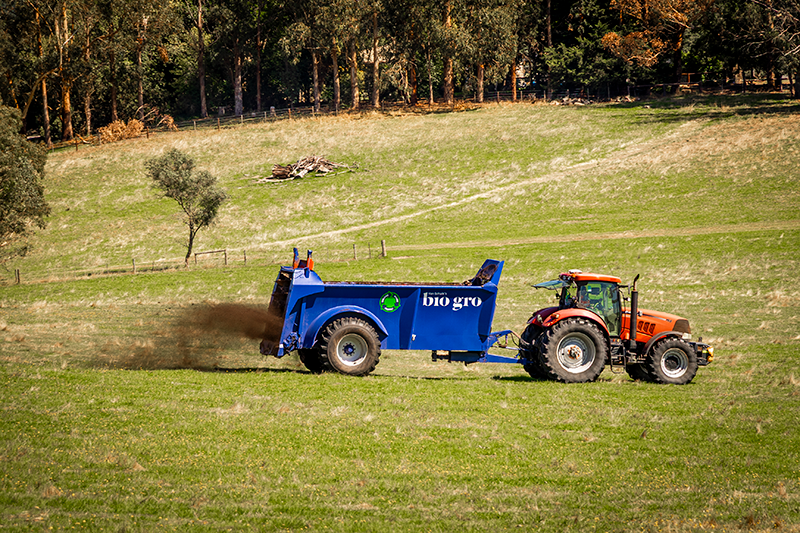
Bio Gro can supply and spread AgriGro, making the process easier for farmers.
For growers considering AgriGro, a practical starting point is to identify the paddocks where additional organic matter may offer the greatest value.
Establish baseline soil nutrient and organic carbon levels, review any existing constraints, and consider the potential contribution of compost within a broader nutrient and soil management plan.
Following application, maintain consistent sampling methods and monitor soil carbon alongside crop or pasture performance. Where practical, untreated comparison areas can help distinguish the effect of the amendment from seasonal variation and other management influences.
Building soil carbon is a long-term process rather than a single-application outcome.
Combining organic inputs with practices that maintain ground cover, retain crop residues and minimise unnecessary soil disturbance can help support that objective.
For farmers across the Limestone Coast and Western Victoria, the opportunity is to make soil improvement decisions based on evidence, track the response and refine the approach over time.
AgriGro can be part of that plan, helping return organic matter to the soil as growers work towards productive and resilient farming systems.
Learn more. Contact us to discuss how Bio Gro can help deliver an AgriGro formulation to improve your soil health, productivity and resilience.